Scientists have teamed up with tiger sharks to uncover the largest expanse of seagrasses on Earth.
A massive survey of the Bahamas Banks — a cluster of underwater plateaus surrounding the Bahama archipelago — reveals 92,000 square kilometers of seagrasses, marine biologist Oliver Shipley and colleagues report November 1 in Nature Communications. That area is roughly equivalent to half the size of Florida.
The finding expands the estimated global area covered by seagrasses by 41 percent — a potential boon for Earth’s climate, says Shipley, of the Herndon, Va.–based ocean conservation nonprofit Beneath The Waves. Seagrasses can sequester carbon for millennia at rates 35 times faster than tropical rainforests. The newly mapped sea prairie may store 630 million metric tons of carbon, or about a quarter of the carbon trapped by seagrasses worldwide, the team estimates.
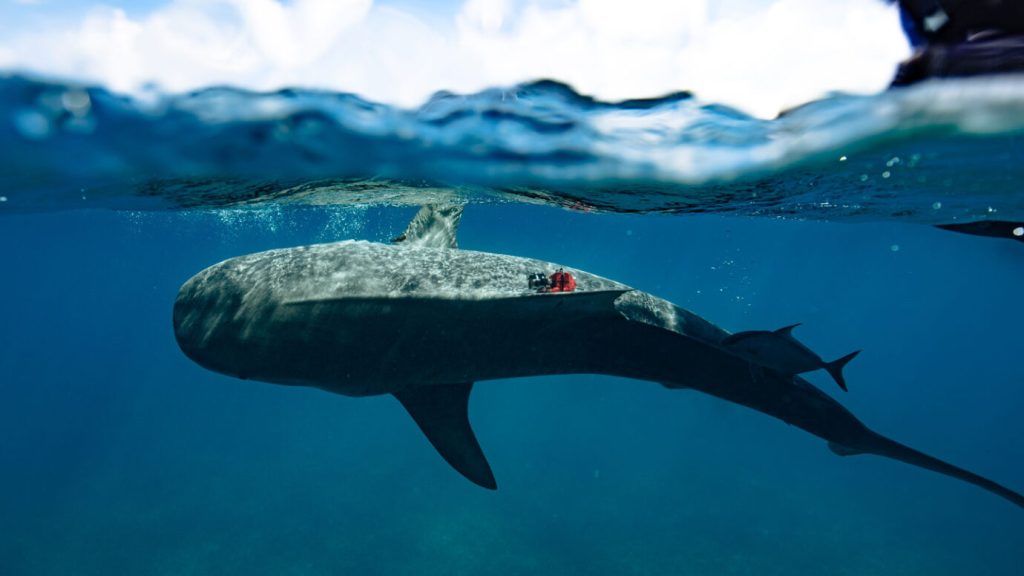
Mapping that much seagrass was a colossal task, Shipley says. Guided by previous satellite observations, he and colleagues dove into the sparkling blue waters 2,542 times to survey the meadows up close. The team also recruited eight tiger sharks to aid their efforts. Similar to lions that stalk zebra through tall grasses on the African savanna, the sharks patrol fields of wavy seagrasses for grazing animals to eat (SN: 1/29/18; SN: 5/21/19, SN: 2/16/17).
“We wouldn’t have been able to map anywhere near the extent that we mapped without the help of tiger sharks,” Shipley says.
The team captured the sharks with drumlines and hauled each one onto a boat, mounting a camera and tracking device onto the animal’s back before releasing it. The sharks were typically back in the water in under 10 minutes. The team operated like “a NASCAR pit crew,” Shipley says.
Researchers had previously suggested tracking seagrass-grazing sea turtles and manatees to locate pastures. But tiger sharks were a smart choice because they roam farther and deeper, says Marjolijn Christianen, a marine ecologist at Wageningen University & Research in the Netherlands who was not involved in the new work. “That’s an advantage.” Shipley and colleagues plan to collaborate with other animals — including ocean sunfish — to uncover more submarine meadows (SN: 5/1/15). “With this [approach], the world’s our oyster,” he says.
Fifty years ago, three NASA astronauts splashed down in the Pacific Ocean, concluding the final Apollo mission. Less than a dozen years after President John F. Kennedy challenged the United States to commit itself to “landing a man on the moon and returning him safely back to the Earth,” that historic program had achieved its goals and ended.
Now, we’re going back. But this time will be different.
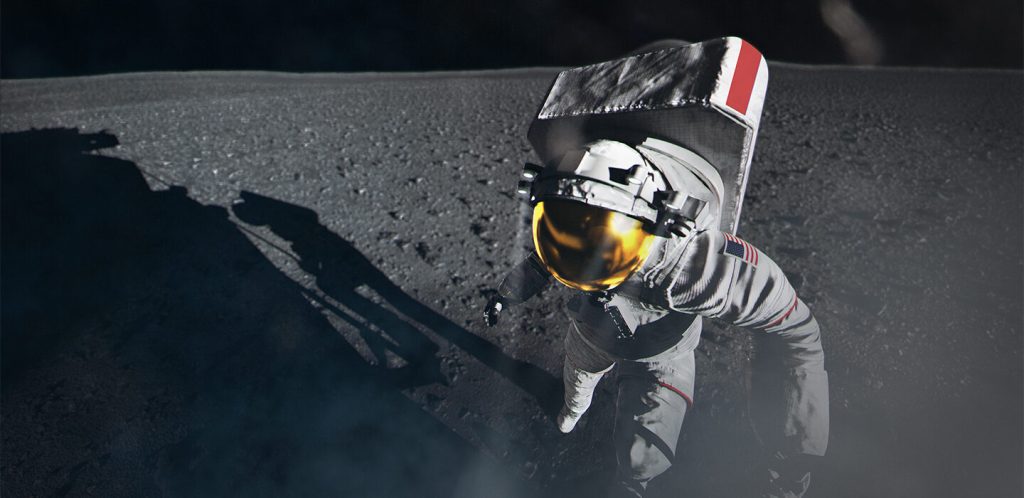
A pivotal moment for the return of crewed missions to the moon occurred at 1:47 a.m. EST on November 16, with the successful launch of Artemis I. NASA’s high-powered Space Launch System rocket roared and crackled as it lifted off the Florida coast on its maiden voyage. The rocket pushed the Orion capsule toward the moon, on a flight testing the technology that will eventually bring astronauts, both men and women, back to the lunar surface.
“It was just a spectacular launch,” says geologist Jose Hurtado of the University of Texas at El Paso, who works with NASA on mission simulations and programs to train astronauts in geology. “It really hits home to me what I love about space exploration, especially human exploration. It’s just an aspirational and inspirational spectacle, and I hope that everybody that was watching it got some of that inspiration.” Now, the United States and China are leading the way to return humans to the moon. The two countries’ programs are massive and complex undertakings with potentially big payoffs. Both aim to boost scientific understanding about the moon and the early Earth, develop new technologies for space exploration and use on Earth, as well as set the stage for longer-term human space exploration.
Better than rovers Apollo was “a technological program to serve political ends,” says space historian Teasel Muir-Harmony. It was rooted in the political tension and conflict between the United States and the Soviet Union. The program “was about winning the hearts and minds of the world public. It was a demonstration of world leadership … of the strength of democracy and then also of capitalism,” says Muir-Harmony, curator of the Apollo Spacecraft Collection at the Smithsonian National Air and Space Museum in Washington, D.C.
Apollo 11 astronauts Neil Armstrong and Buzz Aldrin took the first-ever steps on the moon on July 20, 1969. Over the next few years, 10 more American men hopped, skipped and even drove across the pewter-colored, lifeless terrain of our planet’s only natural companion. Apollo 17 was the final mission in that series of landings, ending on December 14, 1972 (SN: 12/23/72, p. 404). Once Apollo 17 astronauts Eugene Cernan and Harrison H. Schmitt left their footprints embossed in the lunar dust and joined Ronald Evans in the command module, humans stopped walking on the moon.
In the decades since Apollo 17, about two dozen spacecraft from various countries have visited the moon. Some have orbited, others have slammed into the surface so researchers could study the material in the debris of those collisions, and some have landed and brought lunar samples back to Earth (SN: 1/16/21, p. 7).
While these uncrewed spacecraft have made some big strides in lunar exploration, humans could do better. “Nothing can replace the value of having a human brain and human eyes there on the scene,” Hurtado says. One moment during Apollo 17 makes his point. Schmitt, the only geologist to visit the moon, noticed a patch of lunar soil with a particular rusty hue. He walked over, contemplated the surroundings and realized it was evidence of a volcanic eruption. He and Cernan scooped up some of this orange soil for later Earth-based analyses, which revealed that the orange glass blobs in the soil did in fact form during a “fire fountain” explosion some 3.7 billion years ago.
That discovery supported the idea that the moon had hosted volcanoes in its youth, and additional analysis of the orange soil’s chemical composition hinted that the moon formed at around the same time as Earth. Scientists wouldn’t have had access to the orange soil if it wasn’t for Schmitt’s quick grasp that what he saw was important. “Probably the ultimate field tool is the well-trained human,” Hurtado says.
In his 2005 book, Roving Mars, planetary scientist Steven Squyres wrote: “The unfortunate truth is that most things our rovers can do in a perfect [Martian day], a human explorer on the scene could do in less than a minute.” Squyres, of Cornell University, led the Spirit and Opportunity rover missions to Mars (SN: 8/13/22, p. 20).
A long-awaited lunar return Once Apollo ended, NASA shifted its focus to space stations to prepare for longer-term human spaceflight. Skylab launched in May 1973, hosting four crews of astronauts that year and the next. A few years later, the temporary station broke apart in the atmosphere, as planned. NASA’s next space station, the International Space Station, or ISS, was a larger, collaborative project that’s been hosting astronauts since November 2000. It’s still orbiting roughly 400 kilometers above Earth.
U.S. leaders have occasionally tried to shift NASA’s gaze from low Earth orbit, where the ISS flies, to a more distant frontier. Many presidents have proposed investments in different technology for different exploration goals and with different price tags. But by 2019, the plan was set: NASA would land humans on the moon’s south pole in 2024, though the timeline has since slipped.
“The first woman and the next man on the moon will both be American astronauts, launched by American rockets from American soil,” said Vice President Mike Pence in early 2019. Shortly after, NASA named this effort the Artemis program — after Apollo’s mythological twin sister.
The Artemis program is part of NASA’s Moon to Mars program, which aims to send humans farther into space than ever before. The moon is up first, with astronauts stepping on its surface as early as 2025. What the space agency and its partners learn during a few years of lunar exploration will help guide the phases beyond the moon, including sending astronauts to the Red Planet.
“The goal with Artemis is to build off everything we’ve done to this point and really start to establish a presence for humanity beyond low Earth orbit,” says planetary geologist Jacob Bleacher of NASA’s Human Exploration and Operations Mission Directorate in Washington, D.C.
The first big test for Moon to Mars is to show that NASA’s rocket, the Space Launch System, or SLS, which has been in development for over a decade at a cost of more than $20 billion, can successfully launch a crew capsule, without the crew, beyond low Earth orbit.
But that effort has had a rocky start with the Artemis I launch scrubbed twice for fuel leaks and delayed by two hurricanes. Now that it’s off the ground, Artemis I will test the SLS rocket and the Orion advanced crew capsule on a roughly month-long trip beyond the moon and back (SN: 8/26/22). One more test flight, Artemis II, will follow a similar trajectory as the first mission, but with astronauts on board, launching no earlier than 2024.
Artemis III, slated for 2025, is expected to return boots to the moon and make history by landing the first woman on the lunar surface. On that flight, the SLS rocket will launch the Orion crew capsule toward the moon. When it arrives at lunar orbit, it will dock with the human landing system, currently in development by the company SpaceX. Two astronauts will board the SpaceX vehicle, which will bring them to the moon for a 6.5-day stay. That landing system will also bring the astronauts back to Orion, still in lunar orbit, which will then return them to Earth.
If all goes well, NASA plans to run Artemis missions roughly once a year. “We hope to, through those missions that follow Artemis III, build up some infrastructure,” Bleacher says. That infrastructure will include hardware for developing and distributing power on the moon, rovers for the astronauts to traverse long distances and eventually living and working quarters on the surface. The aim is to increase the astronauts’ length of stay from days to perhaps months.
To help support these lunar astronauts, NASA is leading the creation of a new space station. Called the Gateway, it will orbit the moon when complete, maybe by the 2030s. Like the International Space Station, which is scheduled to safely break apart in early 2031, Gateway will be an international and commercial research station. It will also serve as a way station for trips to Mars and beyond. The moon goddess NASA astronauts likely won’t be the only people exploring the lunar surface. China aims to land its own astronauts at the moon’s south pole by the next decade. Begun in 2004, China’s lunar exploration program, Chang’e — named after the Chinese goddess of the moon — has seen fast progress. It “is very systematic, very well done, and they’ve been successful every step of the way,” says planetary geologist James Head of Brown University in Providence, R.I.
In 2018, China put a relay communication satellite in orbit around the moon. In 2019, China landed a rover on the lunar farside, providing the first up-close view of the side of the moon hidden from Earth. That rover is still operating. In November 2020, China sent another rover, which brought samples from the moon’s nearside to Earth the following month.
Next up, although China doesn’t share its specific schedule plans, is Chang’e 6, which will collect and return material from the moon’s farside. In 2026, China intends to launch its Chang’e 7 mission to the south pole to search for water ice. “There’s no question,” Head says, “that [China] will be sending humans to the moon toward the end of the decade.”
China’s human-occupied space station, called Tiangong, is now complete and in low Earth orbit. And Mars exploration is on the menu as well. China landed a rover safely there in 2021 and is gearing up for a sample-return mission in the same time frame as a NASA-European Space Agency sample-return mission to Mars. Science is an international endeavor, but NASA and China’s space agency are unable to collaborate due to the Wolf Amendment (SN: 11/24/18, p. 14). Tacked onto a U.S. appropriations bill in 2011, the amendment prohibits NASA and the White House Office of Science and Technology Policy from collaborating, designing and planning projects with China, unless authorization is granted by the U.S. Congress.
Some lunar scientists, however, hope there can be collaboration between the two nations, such as sharing returned samples. “There are a lot of different places to go in space, and there’s no sense duplicating everything,” Head says.
While human space exploration began as a competition, international collaboration is now the norm. Astronauts from 20 countries have visited the International Space Station over its 22-year history, living together for months and working toward shared interests.
“The International Space Station is a frigging United Nations in orbit in a tin can,” Head says. Private firms also have become increasingly involved in the ISS. And for the Moon to Mars program, international space agencies and private companies are participating, designing and fabricating crucial components. To the south pole When humans step on the moon again, they’ll investigate a never-before-explored locale, the moon’s south pole. It’s a region rich with impact craters, uplifted ancient material and water ice (SN: 11/13/09). Both the United States and China are targeting this area to answer new research questions and to access resources humans would need for an extended stay.
This cratered terrain reveals when rocky material tore through the solar system in the first billion years of its history, slamming into the nascent planets (SN: 4/25/12). Earth no longer tells that history, but the moon, without liquid water or a robust atmosphere to smooth away the evidence, retains a surface record of meteorite impacts over billions of years. “Because that record is so perfectly preserved on the lunar surface, it is the single best place in the entire solar system to understand the origin and early evolution of planets,” says planetary scientist David Kring of the Lunar and Planetary Institute in Houston.
And while those are important mysteries, the south pole’s deep craters also hold something thrilling — water ice. There’s a lot to learn about that ice, says lunar exploration scientist Clive Neal of the University of Notre Dame in Indiana. How much is there? Can it be extracted? How to refine it for human use? The Artemis explorers can address those questions, which would enable even longer-term exploration.
That’s the goal this time around: to stay longer for both science exploration and to learn how humans can have a lasting presence on another celestial body. This work “would extend the bounds of human experience in a way that has never happened before,” the Smithsonian’s Muir-Harmony says.
That’s a tall order, considering how NASA’s schedules keep slipping and the cost estimates for each piece of Moon to Mars keep ballooning. A 2021 audit estimates that by the end of 2025, the cost for the Artemis program will reach $93 billion, some $25 billion over NASA estimates.
These next few years of Artemis flights will show what NASA can do. And China’s upcoming missions will show what that nation’s lunar exploration can achieve. The world will be watching both.
SAN DIEGO — Scientists have devised ways to “read” words directly from brains. Brain implants can translate internal speech into external signals, permitting communication from people with paralysis or other diseases that steal their ability to talk or type.
New results from two studies, presented November 13 at the annual meeting of the Society for Neuroscience, “provide additional evidence of the extraordinary potential” that brain implants have for restoring lost communication, says neuroscientist and neurocritical care physician Leigh Hochberg.
Some people who need help communicating can currently use devices that require small movements, such as eye gaze changes. Those tasks aren’t possible for everyone. So the new studies targeted internal speech, which requires a person to do nothing more than think.
“Our device predicts internal speech directly, allowing the patient to just focus on saying a word inside their head and transform it into text,” says Sarah Wandelt, a neuroscientist at Caltech. Internal speech “could be much simpler and more intuitive than requiring the patient to spell out words or mouth them.”
Neural signals associated with words are detected by electrodes implanted in the brain. The signals can then be translated into text, which can be made audible by computer programs that generate speech.
That approach is “really exciting, and reinforces the power of bringing together fundamental neuroscience, neuroengineering and machine learning approaches for the restoration of communication and mobility,” says Hochberg, of Massachusetts General Hospital and Harvard Medical School in Boston, and Brown University in Providence, R.I.
Wandelt and colleagues could accurately predict which of eight words a person who was paralyzed below the neck was thinking. The man was bilingual, and the researchers could detect both English and Spanish words.
Electrodes picked up nerve cell signals in his posterior parietal cortex, a brain area involved in speech and hand movements. A brain implant there might eventually be used to control devices that can perform tasks usually done by a hand too, Wandelt says.
Another approach, led by neuroscientist Sean Metzger of the University of California, San Francisco and his colleagues, relied on spelling. The participant was a man called Pancho who hadn’t been able to speak for more than 15 years after a car accident and stroke. In the new study, Pancho didn’t use letters; instead, he attempted to silently say code words, such as “alpha” for A and “echo” for E.
By stringing these code letters into words, the man produced sentences such as “I do not want that” and “You have got to be kidding.” Each spelling session would end when the man attempted to squeeze his hand, thereby creating a movement-related neural signal that would stop the decoding. These results presented at the neuroscience meeting were also published November 8 in Nature Communications.
This system allowed Pancho to produce around seven words per minute. That’s faster than the roughly five words per minute his current communication device can make, but much slower than normal speech, typically about 150 words a minute. “That’s the speed we’d love to hit one day,” Metzger says.
To be useful, the current techniques will need to get faster and more accurate. It’s also unclear whether the technology will work for other people, perhaps with more profound speech disorders. “These are still early days for the technologies,” Hochberg says.
Progress will be possible only with the help of people who volunteer for the studies. “The field will continue to benefit from the incredible people who enroll in clinical trials,” says Hochberg, “as their participation is absolutely vital to the successful translation of these early findings into clinical utility.”
Daylight saving time has ended, and most Americans have turned their clocks back an hour. My sixth-grader is in heaven.
At 6:50 a.m. these days, our once testy tween zombie is now … moderately awake and relatively lucid.
Instead of rising to gauzy predawn light, she’s got glowy morning sunshine beaming around her curtains. When she sets off for school, the sun has been up nearly a full hour. Just a 60-minute change has lightened both the morning and her mood. At breakfast today, I think I even spied a smile.
On November 6, every state in the United States except Hawaii and most of Arizona switched from daylight saving time, or DST, to standard time (those two states don’t observe DST). That switch shifted an hour of light from the evening to the morning. In March, we’ll move in the other direction when we “spring forward,” trading morning light for brighter evenings.
The United States’ biannual time change has been lighting up headlines since the U.S. Senate’s unanimous vote in March to make daylight saving time permanent. The Sunshine Protection Act would forgo turning clocks to and fro, repeating an unpopular experiment Congress tried in the 1970s and prioritizing evening light throughout the year. But the health case for staying on daylight saving time is pretty dim. And what such a shift could mean for adolescents is especially gloomy.
Even the name “daylight saving time” isn’t quite right, says Kenneth Wright, a sleep and circadian expert at the University of Colorado Boulder. There’s no change in the amount of daylight, he says. “What we’re doing is changing how we live relative to the sun.” When we move our clocks forward an hour, noon no longer represents when the sun is near its highest point in the sky. Suddenly, people’s schedules are solarly out of sync (SN: 10/17/16).
That’s a big deal biologically, Wright says. Humans evolved with a daily cycle of light and dark. That sets the rhythms of our bodies, from when we sleep and wake to when hormones are released. Morning light, in particular, is a key wake-up signal. When we tinker with time, he says, “we’re essentially making the choice: Do we want to go with what we’ve evolved with, or do we want to alter that?”
From a health perspective, if he had to rank permanent daylight saving time, permanent standard time or our current practice of biannual clock changing, Wright says, “I think the answer is incredibly clear.” Permanent standard time is healthiest for humans, he says. In his view, permanent daylight saving time ranks last.
Daylight saving time takes a toll on health Wright is not alone. As daylight saving time ticked toward its yearly end, sleep experts across the country stepped out in favor of standard time.
Scientists have linked sleep loss, heart attacks and an increased risk of dying in the hospital after a stroke to the transition to daylight saving time, neurologist Beth Malow wrote in Sleep in September. She testified to that this year before a U.S. House of Representatives subcommittee.
“My overall message was that permanent standard time was a healthier choice,” says Malow, of Vanderbilt University Medical Center in Nashville.
For both Malow and Wright, some of the most compelling studies examine U.S. time zone borders. Living on the late sunset side of a border takes a toll on people’s health and sleep compared with those living on the early sunset side, scientists suggested in 2019. A similar study in 2018 also found an increased risk of liver cancer the farther west people lived within a time zone, where the sun rises and sets later in the day.
But the downsides of nighttime light are not always crystal clear. A November study, for example, suggested that year-round daylight saving time would reduce deer-vehicle collisions (SN: 11/2/22). But studies like these can be hard to interpret, Malow says. Other factors may come into play, like deer’s seasonal activity and changing roadway conditions. “The car-crash literature has been so mixed,” she says. “I’ve seen stuff come out on both sides.”
She points to a study in Time & Society in June which found that people on the western edge of a time zone had more automobile fatalities than their easterly neighbors.
Dark mornings and light evenings mean people’s body clocks don’t line up with the sun. That mismatch can hamper sleep, making for drowsy drivers, which may factor into collisions, Malow says. In the evenings, if “there’s still light in the sky, it messes with our brains.” Morning light wakes up the brain The brains of teens and tweens are even more vulnerable, Malow says. When kids go through puberty, the brain waits an hour or two longer to release melatonin, the “hormone of darkness,” which tells the bodies of kids and adults alike that it’s time to go to sleep.
Bedtime can be tough for older kids because, physiologically, they’re just not as sleepy as they used to be. And as I’ve learned with my daughter, if you throw early school start times in the mix, rising and shining can be even harder.
“I have a middle schooler, too. It’s brutal,” says Lisa Meltzer, a pediatric sleep psychologist at National Jewish Health in Denver. Some U.S. school districts are making changes that might make mornings easier. This year, most high schools and middle schools in California debuted later start times. Five years ago, Meltzer’s school district embarked on a similar experiment. What they learned can teach us how older kids might fare if daylight saving time were to stay put year-round, Meltzer says.
In 2017, the Cherry Creek School District in suburban Denver flipped middle and high schools’ early start times with elementary schools’ later ones. The change didn’t much affect younger kids, who still started class well after sunrise, at 8 a.m., says Meltzer, who presented the science behind changing school start times to her school board. But older kids, who started school at 8:20 a.m. or 8:50 a.m., noticed a big difference. They slept more at night and tended to function better during the day, Meltzer’s team reported most recently in the February Sleep Medicine.
“The number one thing [high-schoolers] said was how much they liked going to school when it was light out,” she says.
And it wasn’t just the students. Their teachers, too, felt the benefits of later start times, Meltzer and colleagues report November 6 in the Journal of School Health.
Morning light is crucial for keeping people’s bodies on schedule, Meltzer says. With permanent daylight saving time, kids will not have the same eye-opening, brain-wakening, a.m. sunshine. “We need morning sunlight to keep our internal clocks on track,” she says. “I cannot emphasize this enough.”
So far, the Senate’s plan for year-round daylight saving time has seemed to stall, so the prospect of an everlasting shift toward evening light doesn’t look bright. But come March, when daylight saving time begins anew, we’ll have to adjust again.
For kids struggling with sleep, Sonal Malhotra, a pediatric pulmonologist and sleep doctor at Baylor College of Medicine in Houston, has some tips. Consistency is key, she says: regular sleep, meal and exercise schedules. And when waking up, she adds, “make sure you have bright light.” Malhotra also recommends avoiding afternoon naps and caffeine.
I don’t know if my daughter will ever be bright-eyed and bushy-tailed in the mornings (I’m not), but when mornings eventually get darker, Malhotra’s advice may give us something to fall back on.
You don’t need a dandelion to know which way the wind blows. But it can help.
On any given dandelion, some seeds are destined to go north, while others are fated to fly east, south or west, and every direction in between. In effect, each dandelion seed is programmed to release for a wind coming from one direction and resists winds from other directions, according to research to be presented at the American Physical Society’s Division of Fluid Dynamics in Indianapolis on November 20.
Dandelion seeds are susceptible to different wind directions depending on where they are on the seed head, says Jena Shields, a biophysicist at Cornell University. The feathery seeds on the side facing a breeze will let go most easily; the others hold on tens to hundreds of times tighter — until the wind shifts. It’s a phenomenon that Shields set out to study after her adviser noticed the way dandelions responded as his toddler played with the flowers.
Shields measured the force it takes to pluck dandelion seeds by supergluing a fine wire to the tufted ends and pulling them from the seed heads at various angles. This seed-by-seed study mimicked what happens when wind, or a child’s breath, pushes them over. Because each seed is most susceptible to winds from distinct directions, it helps prevent seeds from all going the same way, Shields says, and may explain why the plants are so successful at spreading. Once blown off a dandelion, the umbrella-like tuft on a seed carries it on the breeze that pulled it away (SN: 10/17/18).
“But a strong, turbulent wind can still send all the seeds flying in the same direction,” Shields says, so the effect can’t guarantee that a powerful gust or exuberant child won’t blow off all the seeds at once.
People pay deerly for the switch from daylight saving time.
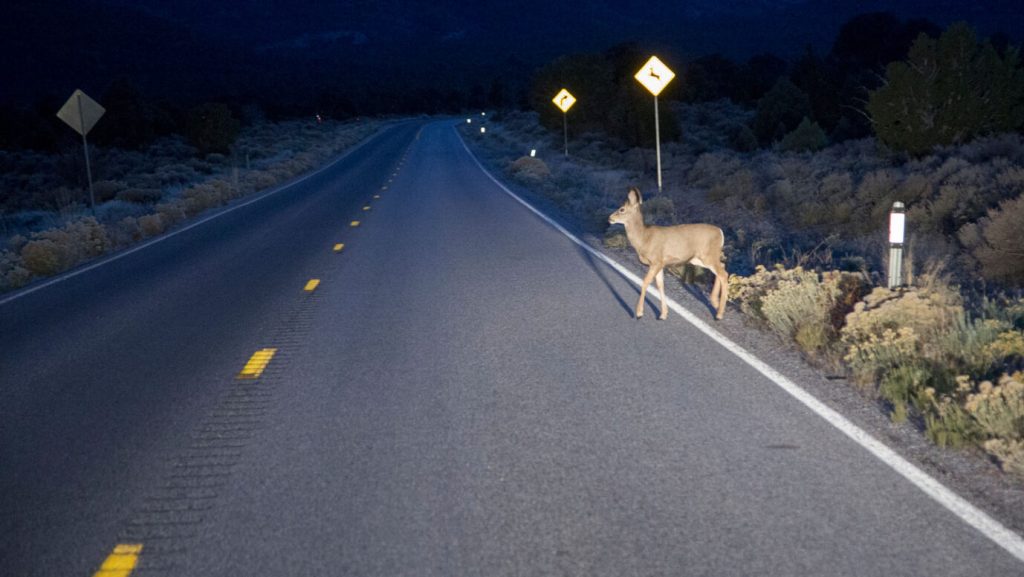
The change to standard time in autumn corresponds with an average 16 percent increase in deer-vehicle collisions in the United States, scientists report November 2 in Current Biology. The researchers estimate that eliminating the switch could save nearly 37,000 deer — and 33 human lives.
In a typical year, there are more than 2 million deer-vehicle collisions — about 7 percent of total vehicle crashes. To see how much the biannual time change impacts those numbers, wildlife biologist Laura Prugh and colleagues compiled data from 23 states that tracked whether a crash involved an animal and what time the crash occurred. The team compared those numbers to traffic volumes for each state between 2013 and 2019, focusing on the weeks before and after the switches to daylight saving time in springtime and back to standard time come fall.
Springing forward had little effect, but almost 10 percent of yearly deer collisions on average took place around the autumn fallback — when the bulk of human traffic shifted to after dark. The problem was especially acute on the East Coast. “You see [a] really steep spike in the fall,” says Prugh, of the University of Washington in Seattle. “In the western states, you also see an increase, but it’s not nearly as sharp.” On the East Coast, the autumn switch falls in the middle of mating season for white-tailed deer. Not only are more drivers active after dark, more deer are too. “The timing could not be worse.”
Eliminating the clock change wouldn’t completely wipe out the spike in crashes — mating season plays a big role, regardless of what time sunset happens. But the scientists estimate that keeping daylight saving time year-round would decrease total deer-human collisions by about 2 percent — saving dozens of people, thousands of human injuries and tens of thousands of deer. It’s another reason for us all to move toward the light (SN: 3/31/14).
The monument consisted of a circle of immense, finely tooled stone archways surrounded by a range of 56 equally spaced [holes].… The precisely proportioned placement of the stones and holes has led archaeologists to presume that the monument had some great astrological significance.… As an alternate explanation, the researchers say perhaps there were 56 families, clans or social units who built Stonehenge and who were entitled to dig one of the [holes] and use it to inter cremated remains.
Update Stonehenge’s purpose remains murky, but the monument’s origin is becoming clearer thanks to science. For at least the first 500 years of its existence, Stonehenge was a cemetery (SN: 5/29/08). A chemical analysis of remains at the site suggests that some of the people interred there came from Wales, more than 200 kilometers west of where Stonehenge stands in southern England (SN: 8/2/18). The monument’s first building blocks also may have come from Wales, repurposed from a stone circle there, but that hypothesis is debated (SN: 2/11/21).
An ancient, armored worm may be the key to unraveling the evolutionary history of a diverse collection of marine invertebrates.
Discovered in China, a roughly 520-million-year-old fossil of the newly identified worm, dubbed Wufengella, might be the missing link between three of the phyla that constitute a cadre of sea creatures called lophophorates.
Based on a genetic analysis, Wufengella is probably the common ancestor that connects brachiopods, bryozoans and phoronid worms, paleontologist Jakob Vinther and colleagues report September 27 in Current Biology.
“We had been speculating that [the common ancestor] may have been some wormy animal that had plates on its back,” says Vinther, of the University of Bristol in England. “But we never had the animal.”
Roughly half a billion years ago, nearly all major animal groups burst onto the scene in a flurry of evolutionary diversification during what’s known as the Cambrian explosion (SN: 4/24/19). During this time, lophophorates experienced a rapid growth of species, which has obscured the group’s evolutionary history. One thing that ties together the different phyla of the group is their tentacle-like feeding tubes known as lophophores. But beyond that commonality, the phyla are all quite different. Brachiopods are shelled animals that at first glance resemble clams. Bryozoans — commonly known as moss animals — are microscopic sedentary critters that live in corallike colonies. And phoronids, or horseshoe worms, are unsegmented, soft-bodied creatures that live in stationary, tubelike structures. (More recently, some researchers have determined that hyoliths — an extinct animal known by their conical shells (SN: 1/11/17) — are also lophophorates because of the tentacled organ that surrounds their mouth.)
Wufengella doesn’t belong to any of these phyla, Vinther and his colleagues found. But the critter has characteristics similar to those of brachiopods, horseshoe worms or bryozoans: a series of asymmetric, armored back plates, a wormlike body and bristles that stick out from lobes surrounding its body. The fossil is a “great find,” says Gonzalo Giribet, an invertebrate zoologist at Harvard University who was not involved in the research. Still, the scientists’ analysis does not confirm that Wufengella is the long-sought missing link, he cautions, but rather suggests it.
Some researchers had hypothesized that lophophorates’ common ancestor would be a stationary creature that sat on the seafloor and fed only through tubes, similar to its modern kin. The Wufengella fossil could refute this idea; the animal’s body plan suggests instead that it crawled around, the researchers say.
A fossil like Wufengella had long been high on Vinther’s bucket list of fossils that he and his colleagues hoped to find. But “we always thought, ‘Well, we probably will never see that in real life,’” he says. Typically, such a creature would have spent its life in shallow water. Organisms don’t tend to preserve well there, decaying faster due to exposure to lots of oxygen. Vinther suggests that the Wufengella that his team found probably washed out to deep water in a storm.
Now that the researchers have found one Wufengella, they hope to find more, in part to see if there are other varieties. And perhaps the team could identify even more distant ancestors further back on the tree of life that might connect lophophorates with other animal groups such as mollusks, Vinther says, further fleshing out how life on Earth is connected.
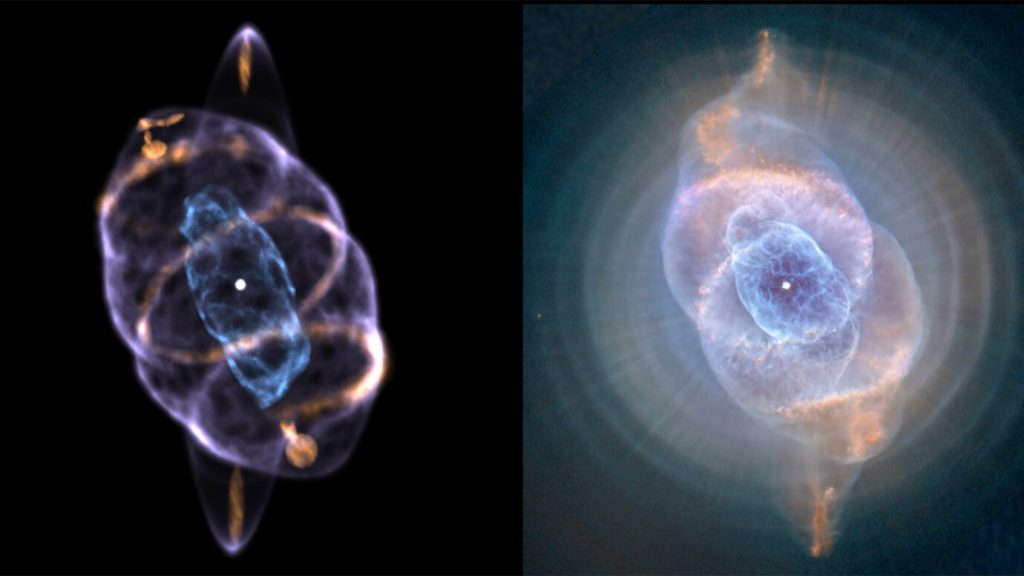
Roughly 3,000 light-years from Earth sits one of the most complex and least understood nebulae, a whirling landscape of gas and dust left in the wake of a star’s death throes. A new computer visualization reveals the 3-D structure of the Cat’s Eye nebula and hints at how not one, but a pair of dying stars sculpted its complexity.
The digital reconstruction, based on images from the Hubble Space Telescope, reveals two symmetric rings around the nebula’s edges. The rings were probably formed by a spinning jet of charged gas that was launched from two stars in the nebula’s center, Ryan Clairmont and colleagues report in the October Monthly Notices of the Royal Astronomical Society.
“I realized there hasn’t been a comprehensive study of the structure of the nebula since the early ’90s,” says Clairmont, an undergraduate at Stanford University. Last year, while a high school student in San Diego, he reached out to a couple of astrophysicists at a scientific imaging company called Ilumbra who had written software to reconstruct the 3-D structure of astronomical objects.
The team combined Hubble images with ground-based observations of light in several wavelengths, which revealed the motions of the nebula’s gas. Figuring out which parts were moving toward and away from Earth helped reveal its 3-D structure.
The team identified two partial rings to either side of the nebula’s center. The rings’ symmetry and unfinished nature suggest they are the remains of a plasma jet launched from the heart of the nebula, then snuffed out before it could complete a full circle. Such jets are usually formed through an interaction between two stars orbiting one another, says Ilumbra partner Wolfgang Steffen, who is based in Kaiserslautern, Germany.
The work won Clairmont a prize at the 2021 International Science and Engineering Fair, an annual competition run by the Society for Science, which publishes Science News. Steffen was skeptical about the tight deadline — when Clairmont reached out, he had just two months to complete the project.
“I said that’s impossible! Not even Ph.D. students or anybody has tried that before,” Steffen says. “He did it brilliantly. He pulled it all off and more than we expected.”
[In the late 1960s], about the best means of cleaning up oil was to put straw on it, then scoop up the oily straw by hand or with pitchforks. Now industry … has devised an arsenal of oil cleanup chemicals. Thin-layer chemicals can be used to herd oil together and to thicken it…. Chemicals are available as absorbents too. Still other chemicals … disperse oil throughout the water. Other chemicals show promise as oil-burning agents.
Update Chemicals are the norm today, but the future of oil-cleanup technology may well be microbial. In recent years, researchers have shown that soil microbes broke down some of the oil from the 2010 Deepwater Horizon spill in the Gulf of Mexico (SN Online: 6/26/15). And electrical bacteria, which channel electricity through their threadlike bodies, could help by turning oil munchers’ waste into fuel for the microbes, scientists reported (SN: 7/16/22 & 7/30/22, p. 24). Microbial mops aren’t yet ready for prime time, so chemical dispersants, fire and spongelike sorbents remain key tools in cleanup kits.