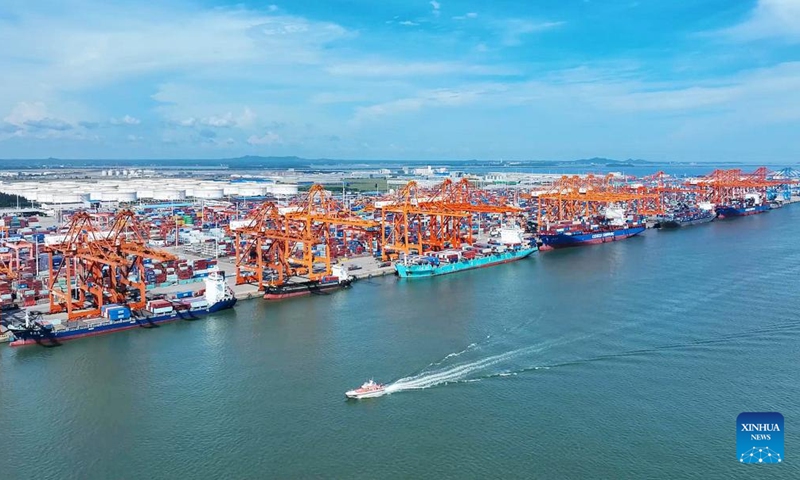
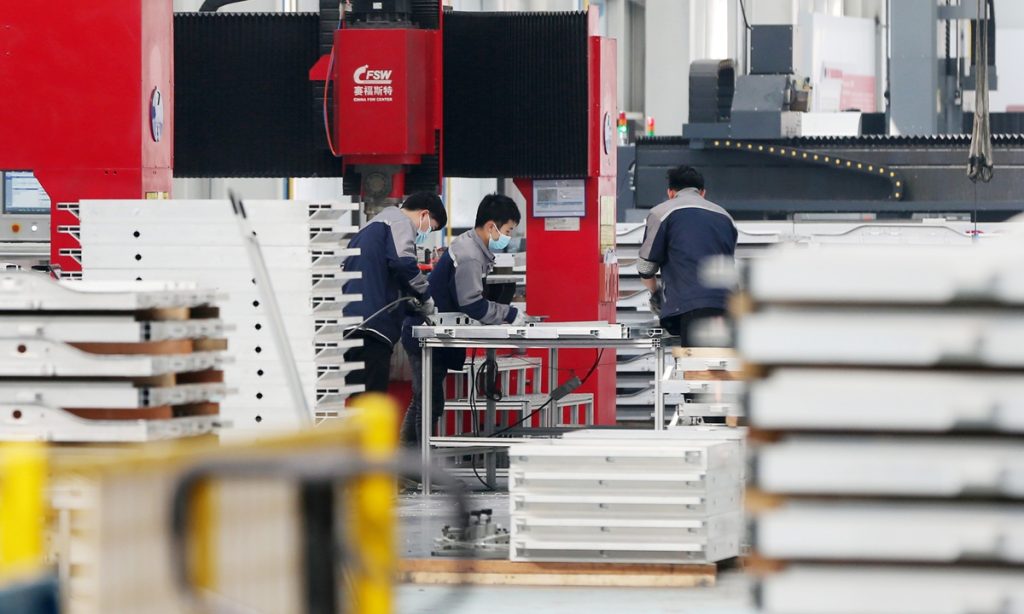
China's commerce ministry will step up efforts in five fields as part of the efforts to building China into a trading power of both quality and quantity, including upgrading cargo trade, seeking innovations in service trade, developing digital trade, deepening international cooperation and safeguarding trade security, Commerce Minister Wang Wentao said in an interview with the People's Daily published on Thursday.
Wang said China's goal of becoming a global trading power is helped by many favorable conditions.
"We can leverage the political advantage of the CPC leadership and the institutional advantages of socialism with Chinese characteristics in pooling resources behind major undertakings. That's our foremost advantage and the fundamental guarantee for building a powerful trade country," Wang said.
In addition, the country's long-term bright economic prospect, powerful production capacity, great innovation potential, ultra-large market and sound infrastructure will all provide strong support, he said.
As the world has entered a new period of turbulence and transformation, economic and non-economic factors are intertwined and "black swan" and "grey gray rhino" events will likely increase. Against this backdrop, China's trade development faces increasingly complex and challenging external environment, Wang said.
He said China's trade sector faces some challenges in 2024, which includes a sluggish global economy, rising protectionism and unilateralism, as well as neighboring countries' measures to attract investment. The growing spillover risks of geopolitical conflicts impact the stability and smooth operation of global supply chains. Climate change and frequent natural disasters may also increase uncertainty.
Wang said the ministry will take advantage of platforms such as the communication mechanism between Chinese and US commerce departments and export control dialogue mechanism between China and the EU as well as between China and Japan in order to narrow the differences and expand more fields of cooperation.
China will actively respond to trade frictions, improve the country's multi-party collaborative response mechanism and properly handle trade frictions, Wang said.
"Faced with unreasonable sanctions and crackdowns, we will take forceful measures to firmly safeguard our country's national interests," Wang said, adding there will be more efforts to strengthen the country's toolkit of countermeasures.
China will take legal actions such as initiating lawsuits at the WTO to safeguard its legitimate rights and interests and make good use of the Unreliable Entity List, he noted.
A lithium mine with nearly one million tons of reserves was newly discovered in Yajiang, Southwest China's Sichuan Province, Xinhua News Agency reported on Thursday, a development which will help raw material supply for China's sprawling electric vehicle sector.
The newly discovered lithium mine was the largest pegmatite lithium deposits in Asia, which was an important breakthrough in China's lithium exploration efforts and will largely assist the nation's carbon neutrality, according to China's Ministry of Natural Resources (MNR).
As a vital mineral which drives development of the new energy sector, lithium is widely used in China's "New Three" export items, new-energy vehicle, lithium battery and solar panels, which together generated 1.06 trillion yuan ($148.89 billion) of exports in 2023, data from China's General Administration of Customs showed.
The distribution of world's lithium resources is uneven, with the metal largely concentrated in South America, Australia, the US and China.
China's lithium reserves are believed to be scattered in various areas while exploration is still in its early stage. The national conference on natural resources held from Monday to Tuesday stressed efforts to enhance domestic lithium mine exploration, along with overseas cooperation so as to secure the material supply for China's growing new-energy sector, according to Xinhua.
Ministry of Natural Resources has vowed to promote lithium mine transfer to increase raw material supply, in a bid to ramp up China's lithium battery manufacturing and market consumption, according to the report.
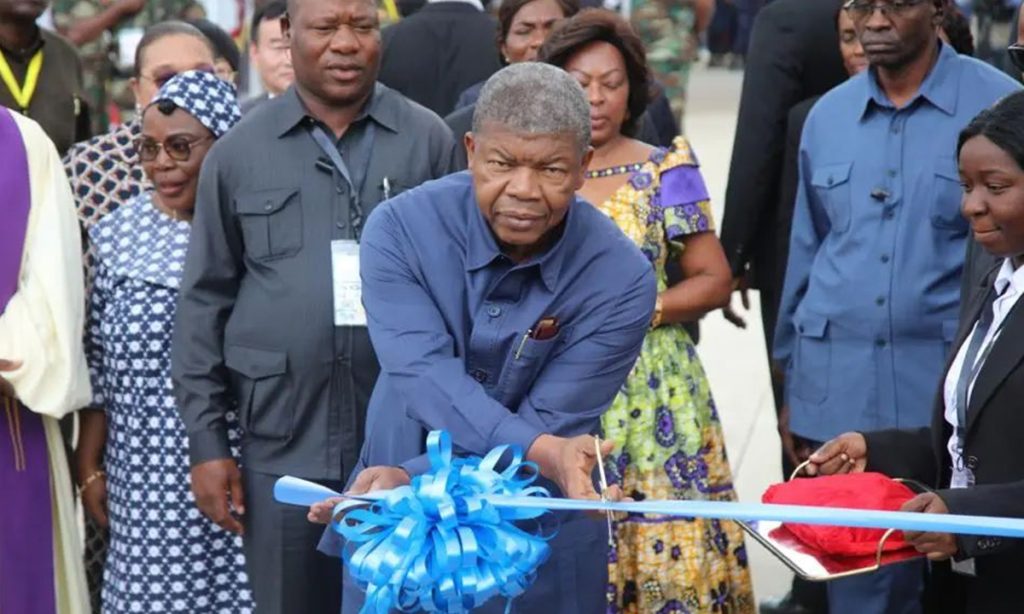
The China-donated Integrated Center for Technological Training (CINFOTEC) Huambo, a vocational skills training center, was officially inaugurated in Central Angola's Huambo on January 12, and is expected to boost Angola's industrial and high-end technology development, the Global Times learned from the state-owned Aviation Industry Corporation of China (AVIC) on Tuesday.
Angolan President João Manuel Gonçalves Lourenço cut the ribbon to mark the official launch of the project at the inauguration ceremony amid applause and public anticipation from thousands of local residents gathered at the site.
At the ceremony, Teresa Dias, Minister of Public Administration, Labor, and Social Security, thanked the Chinese government for its support in the creation of talent in the country and said the inauguration of the center will contribute to the improvement of training quality and help bridge the large gap in the specialization of cutting-edge technology in Angola.
She expressed her expectation that the center would create more opportunities for the development of manufacturing, mining, agriculture, and communication industries in Angola.
Chen Feng, charge d'affaires at the Chinese Embassy in Angola, said the Chinese government has always supported capacity building in Africa. In 2023, China proposed three initiatives to assist in Africa's modernization process, including the Plan for China-Africa Cooperation on Talent Development.
The completion of the center will help more Angolan youth realize their dreams and provide stronger talent support for Angola's independent and sustainable development, she said.
"Over the last 10 to 15 years, China has proven to be Angola's biggest commercial and political partner, with the partnership yielding fruits in various segments, and professional training and employment have been prioritized in these last years," Secretary of State for Labor and Social Security Pedro Filipe said in an interview with the Xinhua News Agency.
At present, Angola has established cooperation projects with a number of Chinese enterprises to provide internship and training opportunities for Angolan youth.
Geraldo Pambasange, the director of CINFOTEC Huambo, said the center will train 2,400 students annually in its first phase, with the first class scheduled to start on January 15.
The project, which was designed and project-managed by the AVIC, covers an area of more than 20,000 square meters. It includes 30 laboratories, and six workshops for robotics, machining, computer science, measurement, and automotive repair. The construction of the project began on June 24, 2021, and it was completed on October 31, 2023.
This project is another high-quality result of Belt and Road Initiative (BRI) cooperation, which will further promote the development of China-Angola relations and deepen the friendship between the two peoples.
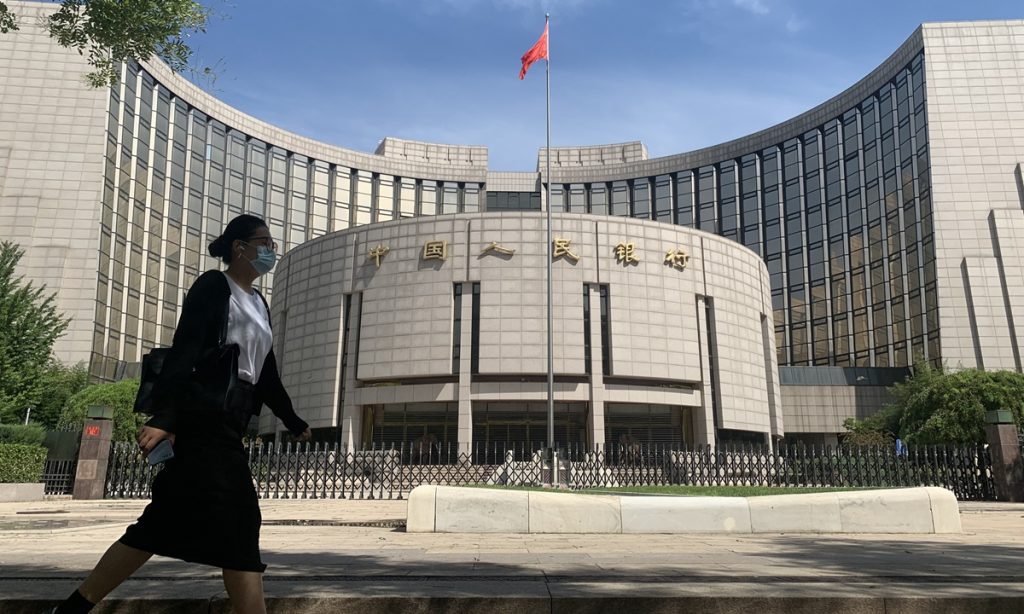
The People’s Bank of China, China’s central bank, on Monday added 995 billion yuan ($138.84 billion) worth of one-year medium-term lending facility (MLF) loans to some financial institutions, but kept the policy rate unchanged.
In order to maintain reasonable and ample liquidity in the banking system, the central bank conducted 89 billion yuan ($12.52 billion) of seven-day reverse repos at an interest rate of 1.8 percent.
In addition, a total of 995 billion yuan was also injected into the market via the MLF, which will mature in one year at an interest rate of 2.5 percent, unchanged compared to the previous operation, according to a statement on the central bank’s website on Monday.
Some market analysts said the central bank is likely to keep the one-year Loan Prime Rate, unchanged too on January 20, as the LPR often mirrors the one-year MLF rate.
Chinese Foreign Minister Wang Yi on Thursday held a phone conversation with his Canadian counterpart Melanie Joly at the latter's request.
Wang, also a member of the Political Bureau of the Communist Party of China Central Committee, said that both China and Canada are countries with important influence in the Asia-Pacific region.
The two countries have neither historical rows nor realistic conflicts of interests, and share many common interests and enjoy complementary advantages, he said.
Wang noted that the current challenging China-Canada relationship is not what China desires, nor is caused by China, while China is open to maintain contact and dialogue with Canada.
Wang put forward three points on improving and developing China-Canada relations:
Firstly, correct cognition. The root cause of the downturn of China-Canada relations in recent years is the serious deviation of the Canadian side's perception of China.
China hopes that the Canadian side can objectively, rationally and correctly interpret China's domestic and foreign policies. China neither exports ideology nor challenges the international order, but has consistently upheld the purposes and principles of the UN Charter, the international system with the UN at its core and the international order based on international law. At the same time, China must firmly safeguard its own sovereignty, security and development interests and never allow the Chinese people to be deprived of their legitimate rights to development, Wang said.
Secondly, mutual respect. The differences in social systems and ideologies between China and Canada stem from their respective histories, cultures, national conditions and people's choices. The two sides should respect each other, engage in dialogue on an equal footing, increase trust, dispel misgivings and strengthen communication responsibly and constructively, so as not to let differences dominate bilateral relations, Wang said.
He also urged the Canadian side to earnestly implement its commitment to the one-China policy, preserve the political foundation of China-Canada relations, and not send any wrong signal to the "Taiwan independence" separatist forces.
Thirdly, win-win cooperation. China will continue to expand high-level opening-up, and Chinese-style modernization will surely bring important development opportunities to Canada and other countries in the world, Wang said.
As promoters and beneficiaries of free trade, China and Canada should jointly oppose the politicization and pan-security of economic issues and create a fair, just and non-discriminatory environment for business development, he added.
Joly, for her part, said that healthy and stable Canada-China relations serve the fundamental interests of the two countries and two peoples.
Despite the difficulties in bilateral relations, Canada is willing to bring bilateral relations back to the right track with a more open, practical and constructive attitude, and is willing to strengthen communication and dialogue with China, promote personnel exchanges, deepen economic and trade cooperation, and maintain close coordination and cooperation on environmental protection, biodiversity and international and regional issues, Joly said.
The 20th Communist Party of China (CPC) Central Commission for Discipline Inspection (CCDI) on Wednesday adopted a communiqué at its third plenary session, pledging to continuously deepen the fight against corruption, seriously investigate and punish corruption in the financial sector, state-owned enterprises, universities, sports, tobacco, medicine, grain purchase and marketing, and statistics, as well as resolutely eliminate systemic corruption risks and hidden dangers so as to comprehensively consolidate a hard-won and overwhelming victory.
The third plenary session was held in Beijing from Monday to Wednesday with 238 attendees and 132 members of the CCDI.
According to the communiqué, as 2024 marks the 75th anniversary of the founding of the People's Republic of China and is a key year for achieving the goals and tasks of the 14th Five-Year Plan (2021-25), the country will continue to do a good job in discipline inspection and supervision this year.
The communiqué stressed that this year will focus on eradicating the conditions that give rise to corruption to deepen the fight against this behavior. Ensuring that officials "do not dare, are not able, and do not want to be corrupt" is the fundamental guideline for battling corruption.
The communiqué said the country will continue to focus on key issues, key areas, key targets, new types of corruption and hidden corruption, and severely punish corruption linked with government and business as the top priority in the battle.
China will deepen efforts to crack down on corruption in finance, state-owned enterprises, energy, tobacco, medicine, infrastructure projects, and bidding, also with focus on cross-border corruption.
China will strengthen joint investigation into bribery as well as officials taking bribes, and improve the joint punishment mechanism for key bribe givers. Also, it will continue to promote national anti-corruption legislation, according to the communiqué.
Li Qiang, Zhao Leji, Wang Huning, Cai Qi and Ding Xuexiang, all members of the Standing Committee of the Political Bureau of the CPC Central Committee, attended the meeting.
Li Xi, a member of the Standing Committee of the Political Bureau of the CPC Central Committee and secretary of the CCDI, presided over the meeting. The session reviewed the work of disciplinary inspection and supervision in 2023, deployed tasks for 2024, and approved the work report on promoting the high-quality development of disciplinary inspection and supervision in the new journey presented by Li.
Xi Jinping, general secretary of the CPC Central Committee, Chinese president and chairman of the Central Military Commission, emphasized at the session on Monday that after 10 years of unremitting anti-graft efforts in the new era, an overwhelming victory has been achieved and fully consolidated, according to the Xinhua News Agency on Tuesday night.
However, the situation remains severe and complex. "We must have a clear understanding of the latest developments and trends in the fight against corruption, and of the soil and conditions that give rise to corruption. The Party must continuously combat corruption with tenacity, perseverance and precision, and resolutely win the tough and protracted battle against corruption," Xi said.
Before and during the three-day third plenary session, China's state broadcaster China Central Television (CCTV) aired the four-episode anti-graft blockbuster Continued Efforts, Deepening Progress for four consecutive days. The documentary, which came to an end on Tuesday, features 12 typical corruption cases, with implicated officials confessing their crimes on camera, including those related to the high-profile anti-corruption efforts covering Chinese soccer. Leaving audiences in shock, the documentary indicates that China's anti-corruption efforts in 2024 will be more potent and thorough, said experts.
Also, judging from the latest communiqué, Chinese experts say that in the new year China will step up its efforts in combating corruption in a deeper dimension, particularly in resource-intensive industries such as the financial and health sectors.
Tang Renwu, dean of the School of Governance of Beijing Normal University, told the Global Times on Wednesday that an unprecedented achievement in anti-corruption was made in 2023 as the largest number of corrupt officials were arrested since the 18th CPC National Congress in 2012.
In the first nine months of 2023, Chinese discipline inspection and supervision agencies filed around 470,000 cases, with 12,000 individuals involved in bribery cases. A total of 45 senior officials were investigated in 2023, the highest number since 2012.
The crackdowns on corruption will further intensify, which can serve as a crucial deterrence to corrupt officials, Tang said, noting the comprehensive anti-graft drive is welcomed and supported by the people.
Although the country has gained a decisive victory in the fight against corruption, there is still a long way to go and the next step should be to improve and establish a system in which officials won't desire to commit corruption, which will be the major task for 2024, Tang said.
The 20th Communist Party of China (CPC) Central Commission for Discipline Inspection (CCDI) on Wednesday adopted a communiqué at its third plenary session, pledging to continuously deepen the fight against corruption, seriously investigate and punish corruption in the financial sector, state-owned enterprises, universities, sports, tobacco, medicine, grain purchase and marketing, and statistics, as well as resolutely eliminate systemic corruption risks and hidden dangers so as to comprehensively consolidate a hard-won and overwhelming victory.
The third plenary session was held in Beijing from Monday to Wednesday with 238 attendees and 132 members of the CCDI.
According to the communiqué, as 2024 marks the 75th anniversary of the founding of the People's Republic of China and is a key year for achieving the goals and tasks of the 14th Five-Year Plan (2021-25), the country will continue to do a good job in discipline inspection and supervision this year.
The communiqué stressed that this year will focus on eradicating the conditions that give rise to corruption to deepen the fight against this behavior. Ensuring that officials "do not dare, are not able, and do not want to be corrupt" is the fundamental guideline for battling corruption.
The communiqué said the country will continue to focus on key issues, key areas, key targets, new types of corruption and hidden corruption, and severely punish corruption linked with government and business as the top priority in the battle.
China will deepen efforts to crack down on corruption in finance, state-owned enterprises, energy, tobacco, medicine, infrastructure projects, and bidding, also with focus on cross-border corruption.
China will strengthen joint investigation into bribery as well as officials taking bribes, and improve the joint punishment mechanism for key bribe givers. Also, it will continue to promote national anti-corruption legislation, according to the communiqué.
Li Qiang, Zhao Leji, Wang Huning, Cai Qi and Ding Xuexiang, all members of the Standing Committee of the Political Bureau of the CPC Central Committee, attended the meeting.
Li Xi, a member of the Standing Committee of the Political Bureau of the CPC Central Committee and secretary of the CCDI, presided over the meeting. The session reviewed the work of disciplinary inspection and supervision in 2023, deployed tasks for 2024, and approved the work report on promoting the high-quality development of disciplinary inspection and supervision in the new journey presented by Li.
Xi Jinping, general secretary of the CPC Central Committee, Chinese president and chairman of the Central Military Commission, emphasized at the session on Monday that after 10 years of unremitting anti-graft efforts in the new era, an overwhelming victory has been achieved and fully consolidated, according to the Xinhua News Agency on Tuesday night.
However, the situation remains severe and complex. "We must have a clear understanding of the latest developments and trends in the fight against corruption, and of the soil and conditions that give rise to corruption. The Party must continuously combat corruption with tenacity, perseverance and precision, and resolutely win the tough and protracted battle against corruption," Xi said.
Before and during the three-day third plenary session, China's state broadcaster China Central Television (CCTV) aired the four-episode anti-graft blockbuster Continued Efforts, Deepening Progress for four consecutive days. The documentary, which came to an end on Tuesday, features 12 typical corruption cases, with implicated officials confessing their crimes on camera, including those related to the high-profile anti-corruption efforts covering Chinese soccer. Leaving audiences in shock, the documentary indicates that China's anti-corruption efforts in 2024 will be more potent and thorough, said experts.
Also, judging from the latest communiqué, Chinese experts say that in the new year China will step up its efforts in combating corruption in a deeper dimension, particularly in resource-intensive industries such as the financial and health sectors.
Tang Renwu, dean of the School of Governance of Beijing Normal University, told the Global Times on Wednesday that an unprecedented achievement in anti-corruption was made in 2023 as the largest number of corrupt officials were arrested since the 18th CPC National Congress in 2012.
In the first nine months of 2023, Chinese discipline inspection and supervision agencies filed around 470,000 cases, with 12,000 individuals involved in bribery cases. A total of 45 senior officials were investigated in 2023, the highest number since 2012.
The crackdowns on corruption will further intensify, which can serve as a crucial deterrence to corrupt officials, Tang said, noting the comprehensive anti-graft drive is welcomed and supported by the people.
Although the country has gained a decisive victory in the fight against corruption, there is still a long way to go and the next step should be to improve and establish a system in which officials won't desire to commit corruption, which will be the major task for 2024, Tang said.
China's economy experienced a steady rebound in 2023, exceeding international expectations. In the face of an unstable world economy, China persisted in seeking progress while maintaining stability. While properly preventing and tackling risks, China continues to move forward with its economic recovery. In the process, it keeps deepening reforms and expanding opening-up. New growth drivers and competitive advantages are continuously emerging. This year, with the introduction of more support policies, China's economy is expected to maintain stable and positive momentum. The Global Times invited two Chinese economists to discuss the economy's opportunities in 2024.
Despite considerable difficulties, the global economy in 2023 achieved several important goals, including a moderate growth and containing inflation. Global GDP growth in 2023 largely exceeded initial expectations, and the performance of most economies was better than originally forecasted.
Looking ahead to 2024, this improvement is likely to continue. In 2023, the supply-demand balance in the labor market was stabilizing, with a decrease in job vacancies and no significant increase in unemployment rates. The job vacancy rates in the world's other major economies remain elevated compared with the levels implied by economic fundamentals, indicating further room for improvement.
Inflation is expected to spiral down in 2024. Since the end of 2022, the core inflation rates of all G10 economies, except for Japan, have dropped from 6 percent to around 3 percent. Central banks have completed most of the adjustments to control inflation, and nominal wage growth has started to slow down. Therefore, the possibility of a resurging inflation in 2024 is low.
In an environment of lower inflation and a strong labor market, disposable income in developed markets is expected to significantly increase. However, just like the divergence between Europe and the US in 2023, the divergence in 2024 will still be evident, albeit with reversed positions. It is projected that the real income growth in the US, which was 4 percent in 2023, will slow down, while the Eurozone and the UK will have more room for real income growth as the impact of Russian gas supply shock subsides.
Additionally, as inflation stabilizes, monetary policy tightening will gradually be phased out. Although they will still have an impact on GDP growth in the first half of the year, the drag on the economy will be smaller than in 2023. If the growth outlook is unfavorable, interest rate cuts may become a policy option. Several emerging markets that started raising interest rates earlier have begun to lower policy rates and may continue to do so this year.
The manufacturing sector is expected to recover from a slump in 2023. The export of goods from major exporting countries such as the US, Japan, South Korea, and Southeast Asia significantly contracted in last year, and the World Bank predicts that global trade growth rate in 2023 will reach 1.7 percent, much lower than the 6 percent in 2022. In the second half of 2023, global trade begins to slowly rebound, and the export growth rates of the US, Japan, South Korea, India, and Vietnam all turn from negative to positive. In 2024, global trade growth is likely to follow a moderate growth pattern.
In 2023, China successfully navigated many external headwinds, overcame internal challenges and made progress in deepening reform and opening-up. The country also implemented effective macroeconomic regulations, prioritized the expansion of domestic market demand, optimized economic structure, instilled confidence, and effectively managed and resolved risks. The economy experienced a strong rebound in 2023.
The Organization for Economic Cooperation and Development (OECD) has raised its growth estimate for China's economy in 2023 to 5.2 percent, while the IMF has increased it to 5.4 percent. Several financial institutions, including Morgan Stanley, Goldman Sachs, Citigroup, UBS, Deutsche Bank and ANZ, have also raised their growth estimates to 5-5.7 percent. This indicates that China remains a major driving force for economic growth in the Asia-Pacific region and the world.
In 2023, China's economy underwent a structural transformation and upgrade, with home consumption showing an impressive growth among the three major driving forces. Despite the time lag effect for the recovery due to the lingering effects of the COVID-19 pandemic, in-person consumption and services consumption rebounded relatively quickly. Also, new types of consumption and consumption upgrades, such as digital and green sector explorations, cultural tourism and sports, maintained strong momentum.
From the perspective of exports, the "new three items," namely electric vehicles, solar panels, and lithium batteries are becoming the new growth drivers for China's exports. Sales of these products are booming, which is the result of China's technological innovation and industrial optimization and upgrading.
As the only country that has all categories in the UN industrial classification system, China has a complete range of industrial products and well-established industry and supply chains required for producing the "new three items." With China's continuous role in innovation leadership and the deepening of its green transformation, high-tech industries are injecting new momentum into China's economic growth.
China's manufacturing sector has shown strong recovery momentum, as the inventory is consistently thinned. Industrial production has entered the "inventory replenishment" stage.
From an investment perspective, the development of emerging service industries has become a new force in addition to manufacturing, infrastructure and exports. The proportion of high-tech services industries in fixed-asset investment is only slightly lower than that of real estate. The high-tech services industry has maintained steady growth, which is not only beneficial for optimizing the nation's investment structure but also for the further transformation and upgrading of the manufacturing sector.
From the perspective of economic and trade relations, the relationship between China and the US is being stabilized, while China's economic and trade relations with emerging markets continue to strengthen. In the first eight months of 2023, the proportion of exports to emerging and developing economies in China's total exports rose from 25 percent in 2007 to 44 percent. Amid the complex global situation, this further enhances the resilience of China's economic cooperation.
In preventing and tackling risks, some provinces in China have issued special-purpose refinancing bonds worth nearly 1.5 trillion yuan ($210 billion) since October 2023. The funds raised are primarily used to repay outstanding debts owed by local governments to enterprises. The issuance of these special-purpose refinancing bonds signifies a new stage in the prevention and resolution of local government debt.
International financial institutions such as UBS and Goldman Sachs generally predict that emerging markets will experience a rapid rebound this year, with the important driving force being the development of the Chinese economy.
In 2024, with the implementation of a series of policy measures by the Chinese government and the growth of private-sector investment, the economy is expected to further gain pace to expand. China's economy will maintain medium- to long-term growth, and the government will ramp up efforts to stabilize growth, providing support for the economy.
In 2024, the green economy, digital economy and intelligent economy will become the new "three engines" driving growth, while consumption upgrading will also quicken its pace, potentially boosting economic growth. With the weakening of the US dollar and intensified policy measures, the vitality of the Chinese economy will be unleashed fully, and economic growth will gradually return to normal.
In 2023, the global economy faced a spate of turbulences. In 2024, instability, uncertainty and unpredictability may become the new normal. Political turmoil brought about by multiple national elections is bound to affect the global political and economic landscape.
The upcoming US election could bring uncertainties to the pace of the global economic recovery. Europe is confronted with the dilemma of regional conflicts and an energy transition, facing the difficult choice between inflation and deflation, and lowering interest rates or maintaining at the present levels. The outlook remains highly uncertain.
In the face of this complex and ever-changing international situation, China will continue to implement strategic initiatives, adhere to bottom-line thinking, calmly respond and focus on its own affairs. China will respond to the uncertainty of external environmental changes with its own certainty.
The Tongliang Dragon is dubbed as the "No.1 Dragon in China" both at home and abroad. Tongliang Dragon Dance and Tongliang Dragon Lantern Caizha (colorful silk handicraft) are two national intangible cultural heritages (ICHs) in the district of Tongliang, Southwest China's Chongqing Municipality.
In recent years, the district has used the dragon culture as a leverage to strengthen the systematic protection of ICHs through continued innovation and development.
A large-scale ICH live show "Dream Chasing - Tongliang Dragon" was staged at the Xuantianhu Dragon Dance Square, which has renovated the arena to enhance audiences' visual experience.
The extravaganza is set against the backdrop of Tongliang's dragon culture and centers on Chinese folktale "Carp Leaps into the Dragon's Gate," telling a story of how Chinese people uphold the spirit of the dragon, stay true to their original aspiration, work hard, pursue their dreams and ultimately achieve success.
The Dragon Dance show showcases various ICH performances, including the Tongliang Dragon Dance and Lantern Dance, allowing the audiences to better experience ICHs and promote traditional Chinese culture.
The Tongliang Dragon Dance is a precious cultural resource that has enabled the sustainable and healthy development of dragon culture for thousands of years. Today, this culture has entered elementary and secondary schools and has been documented in local textbooks.
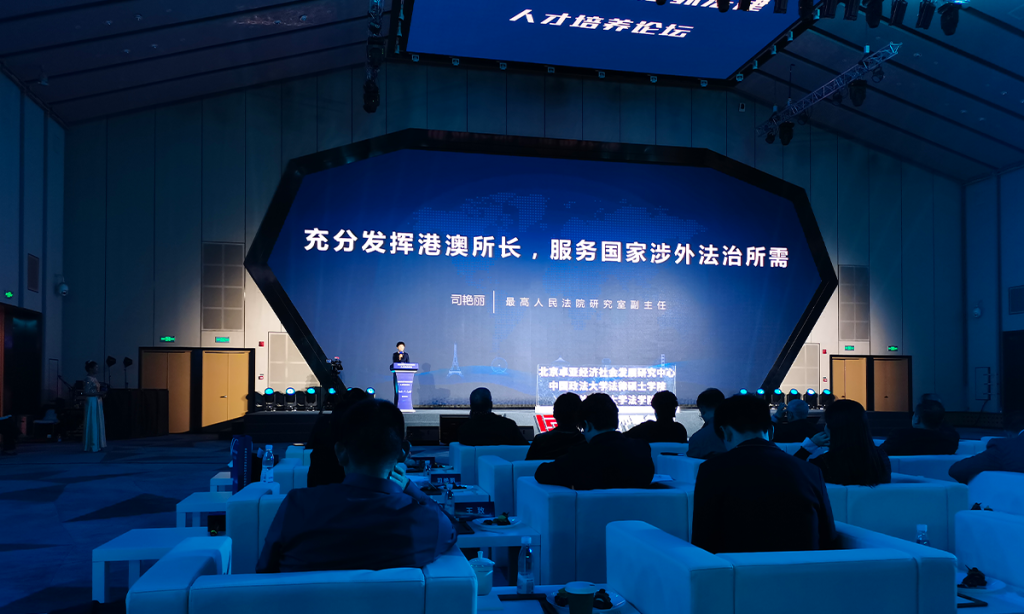
A forum focusing on enhancing China's foreign-related legal system and the cultivation of talents in the niche legal field was launched on Sunday in Beijing.
The event was attended by several Chinese experts in the legal field. Some of them were veterans of the "court" organ while others were scholars of law departments at China's higher-education schools such as Beijing Foreign Studies University.
The forum represents China's all-round efforts to strengthen its foreign-related legal system, which Chinese President Xi Jinping emphasized at the 10th collective study session held by the Political Bureau of Communist Party of China CPC Central Committee on November 27.
Qiao Xiaoyang, the former chairman of the National People's Congress Law Committee, gave an opening speech to indicate the urgency of boosting the foreign-related legal system as in the international legal community China has gone from being a "calm rational observer" to a "participant in making regulations with the integrity of justice and equality."
"By enhancing our 'legal confidence,' we can amplify the country's discourse power in the international legal community while allowing us to become better connected to the world," Qiao remarked.
Tribunal experts such as Gao Xiaoli and Si Yanli shared their insights on detailed legal aspects such as establishing mechanisms for international commercial dispute settlements as well as how to boost China's foreign law relations with the world by borrowing the developing strengths of the Guangdong-Hong Kong-Macao Greater Bay Area (GBA).
Gao, a judge with the China International Commercial Court (CICC), said that thanks to China's prosperous and growing Belt and Road Initiative (BRI), the country's business exchanges with the world are surging and fruitful but it is also unavoidable that business conflicts will emerge.
She then proposed to establish a "comprehensive legal platform" that can provide a "one-stop service" to deal with international business disputes. The platform includes not only tribunal and council facilities, but should have a combined mechanism of "arbitrament" and "legal mediation" for disputes to be settled in the most "low cost and efficient" way.
In September, the fourth batch of typical international business dispute cases were revealed by the Supreme People's Court of China. By collaborating with 10 international commercial arbitration institutions, more than 7,891 cases have been settled in the past five years, including international cases involving countries such as Thailand, Italy and the US.
As the heart of China's international trading, the GBA exhibits China's legal confidence by embracing diverse legal systems. Si, the deputy director of the research department of the Supreme People's Court of China, has encouraged more "frequent exchanges" between legal institutions in the Chinese mainland and the Hong Kong and Macao Special Administrative Regions.
Wang Junhui, an international legal expert, told the Global Times that more exchanges can help Chinese mainland enterprises "go global."
"The emergence of such new strategies in the legal field also reflect China's growing social modernization. Laws should keep up with the times too," Wang told the Global Times.
To support such social-legal strategies, nation-wide legal education should keep up to provide the country with more talents and think tanks.
At the event, experts such as Wang Haiyan, the head of the Academic Office of China University of Political Science and Law, shared a unique educational strategy to cultivate "interdisciplinary talents."
A legal student should be trained with knowledge in foreign languages, economy and finance as well as cultural studies.
"We are seeking to train young Chinese legal workers who know how to deliver legal points in context with their own narrative systems and ideologies," the expert noted.
The event was held at the CP Center an co-organized by the Law School of Beijing Foreign Studies University, School of Juris Master in China University of Political Science and Law and the Beijing Zhuoya Research Center for Economic and Social Development.