China calls for truly lasting ceasefire in Gaza at UN Security Council open debate
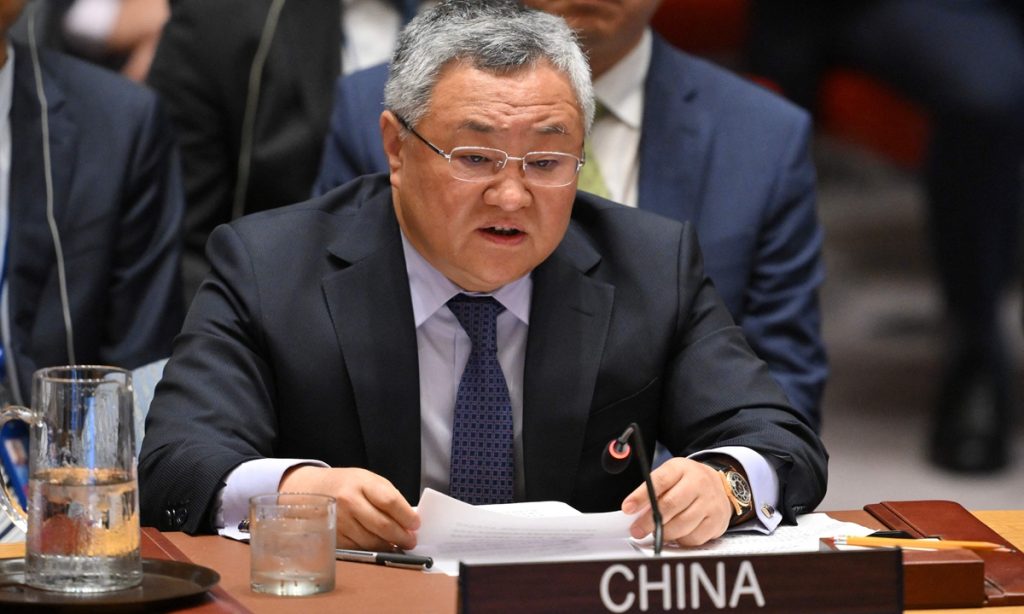
Fu Cong, China's Permanent Representative to the United Nations (UN), called for a truly lasting ceasefire in Gaza at a UN Security Council open debate on the Palestinian-Israeli issue on Tuesday, the Xinhua News Agency reported. 

Fu said that the Gaza ceasefire agreement has yet to bring real peace, with the humanitarian crisis in Gaza remaining severe. Essential supplies are in short supply, sanitary conditions are dire, and more than 2 million people are struggling to survive amid the ruins. He stressed that history has repeatedly shown that security is mutual, and no country can build its own security on the insecurity of others. He added that military occupation and pressure will not help achieve lasting peace.

China calls on all parties concerned, particularly Israel, to fully comply with the ceasefire agreement and realize a truly durable ceasefire in Gaza, Fu said. Israel, as the occupying power, must fulfill its obligations under international humanitarian law, lift restrictions on the entry of humanitarian supplies, and support and ensure the work of humanitarian agencies, including the United Nations Relief and Works Agency for Palestine Refugees in the Near East (UNRWA).

The situation in the West Bank of Jordan river continues to deteriorate, Fu said. China urges Israel to immediately halt settlement activities, curb settler violence, and ensure accountability for related attacks. Israel should lift unreasonable restrictions on the West Bank's economy, return withheld tax revenues as soon as possible, and stop undermining the governance foundation of the Palestinian Authority, Xinhua reported. 

Fu emphasized that the "two-state solution" is the only viable way out of the Palestinian question, and it must not be denied or replaced. The international community should further build consensus, reinvigorate the prospects of the two-state solution, reject any attempts to change the demographic or territorial structure of Palestine, and oppose unilateral actions that undermine its foundation. Fu called for support for the establishment of an independent State of Palestine based on the 1967 borders, with East Jerusalem as its capital, enjoying full sovereignty.

Fu said the Palestinian question has dragged on for decades, and the basic framework for its resolution has long been established. The path to peace lies ahead, requiring political will and courage. War cannot last forever, and understanding and mutual trust must ultimately be built. 

China calls on all parties to prioritize the well-being of the Palestinian people and the stability of the Middle East, work together to advance a comprehensive, just and lasting solution to the Palestinian question, and China stands ready to continue making unremitting efforts to this end, Fu said, Xinhua reported. 

Taipei Zoo celebrates 6th birthday of mainland giant pandas' youngest offspring

Taipei Zoo on Sunday celebrated the sixth birthday of Yuanbao, the youngest offspring of a pair of giant pandas presented by the mainland to Taiwan in 2008.

Despite currently being closed to the public for maintenance, Taipei Zoo on Sunday morning did a live-streaming session of about 30 minutes showing Yuanbao enjoying specially prepared treats, including a birthday cake, fruits and toys.

Yuanbao was born in 2020, following the birth of her sister Yuanzai in July 2013, to the giant panda pair Tuantuan and Yuanyuan. The male Tuantuan died from a cerebral tumor in 2022 shortly after his 18th birthday, having lived at the zoo for 14 years.

According to Wang Chien-po, curator of the Giant Panda House at the Taipei Zoo, the birthday treats this year were designed to help Yuanbao cope better with behavioral changes suspected to be caused by pseudopregnancy, a cycle her sister and mother have previously experienced.

During a pseudopregnancy, female giant pandas tend to eat less, move less and sleep for longer periods, thereby going through similar changes as they would if they were pregnant.

The zoo hopes to enrich the environment for Yuanbao to encourage her to explore more and eat more during her pseudopregnancy, Wang explained.

Chinese FM meets Iran's Supreme National Security Council deputy secretary

Chinese Foreign Minister Wang Yi on Monday met with Qadir Nizamipour, deputy secretary of Iran's Supreme National Security Council, in New Delhi.

During the meeting, Wang, also a member of the Political Bureau of the Communist Party of China Central Committee and director of the Office of the Central Commission for Foreign Affairs, said that China welcomes the launch of follow-up consultations -- with the assistance of Pakistan and Qatar -- between Iran and the United States based on the Memorandum of Understanding (MoU) signed between the two countries, as well as the consensus reached on the mechanism for the next phase of negotiation.

The core provisions of the 14-point MoU are hard-won, said Wang, adding that effectively maintaining and implementing the MoU will help consolidate the hard-won ceasefire situation, open up new prospects for Iran-U.S. relations, and help bring peace back to the Middle East region, said Wang.

Wang noted that China, as a comprehensive strategic partner of Iran, has always maintained a fair position and supported all efforts conducive to peace, supported Iran in safeguarding its sovereignty, security and national dignity, and supported Iran in improving relations with the Gulf countries and regional countries.

China is willing to continue to provide assistance in its own way and play a constructive role in restoring regional peace and tranquility at an early date, he added.

China has always viewed and advanced China-Iran relations from a strategic and long-term perspective, and is willing to work with Iran to enhance high-level exchanges, consolidate political mutual trust, deepen practical cooperation and promote the steady and long-term development of bilateral relations, said Wang.

On his part, Nizamipour briefed on the latest situation in the Middle East and the negotiations between Iran and the United States. He expressed the hope that China can continue to play an important role in facilitating the effective implementation of the first-phase MoU between Iran and the United States.

Nizamipour said that Iran has always attached great importance to its relations with China and highly appreciates the positive role China has played in international and regional affairs, adding that deepening the comprehensive strategic partnership between the two countries is the consensus of all sectors in Iran.

Iran firmly adheres to the one-China principle and is willing to further enhance exchanges at all levels with China, strengthen mutual support, tap cooperation potential, and enhance collaboration under multilateral frameworks such as BRICS to jointly address common challenges, Nizamipour said.

Both Wang and Nizamipour are in New Delhi to attend the 16th Meeting of BRICS National Security Advisors and High Representatives on National Security.

China to continue providing assistance for Middle East peace, FM stresses US commitment to ceasefire accord

In response to a question about how China, as Iran's comprehensive strategic partner, might leverage its influence to ensure US compliance with the ceasefire agreement and help Iran achieve peace, Chinese Foreign Ministry spokesperson Guo Jiakun said on Wednesday that China stands ready to continue providing assistance in its own way, guided by the four-point proposal for promoting peace and stability in the Middle East, and to play a constructive role in restoring regional peace and stability at an early date.

Guo said China has always maintained that regional hot-button issues and differences between parties should be resolved through dialogue and negotiation, and opposes the use or threat of force. 

The Memorandum of Understanding signed by the US and Iran, in which they commit to respecting each other's sovereignty and territorial integrity, refraining from any further military actions, and avoiding interference in each other's internal affairs, sends a positive signal to the international community, said Guo, adding that this commitment should be jointly upheld and implemented.

China has always taken an impartial stance, supporting all efforts conducive to peace, supporting Iran in safeguarding its sovereignty, security and national dignity, and supporting Iran in improving its relations with Gulf countries and other regional states, the spokesperson said.

China to host inaugural Xiong'an Global Governance Forum

China will host the inaugural Xiong'an Global Governance Forum this autumn, according to a press conference held by China's State Council Information Office on Wednesday.

The event, to be held in the Xiong'an New Area in north China's Hebei Province, is expected to bring together all parties to discuss ways to reform and improve global governance, according to the press conference.

Should DPP authorities dare to provoke, they must bear all consequences, says mainland spokesperson on DPP’s claim of coast guard vessel standoff

When asked to comment on the claim by the Democratic Progressive Party (DPP) authorities that a Chinese mainland coast guard vessel entered the so-called “restricted waters” of the Dongsha Island on June 5, triggering a vessel standoff, Zhang Han, a spokesperson for the Taiwan Affairs Office of the State Council, said on Wednesday that China has indisputable sovereignty over the South China Sea islands, including the Dongsha Island, and their adjacent waters. 
The law enforcement patrols conducted by the Chinese mainland coast guard in relevant waters are a normal exercise of its duties. Should the DPP authorities dare to provoke, they must bear all the consequences arising therefrom, Zhang added.

Chinese expert criticizes Filipino FM’s claim that Japan-Philippines delimitation ‘nothing to do’ with China, warns move serves ulterior purposes beyond bilateral talks

In response to the Philippine foreign minister's claim that its boundary discussions with Japan "have nothing to do" with China, a Chinese expert on Thursday said the so‑called Japan-Philippines maritime delimitation talks concern an area east of China's Taiwan island and contradict international law and the United Nations Convention on the Law of the Sea. The expert noted the move carries ulterior purposes beyond bilateral discussions.

Philippine Secretary of Foreign Affairs Maria Theresa Lazaro said that establishing clear maritime boundaries between the Philippines and Japan is of vital importance to the country's national defense in an interview on Wednesday.

China has criticized such negotiations, while Lazaro claimed the discussion "has nothing to do with them" and "just between the Philippines and Japan." She added, "We should continue with our delimitation talks," even if China keeps objecting or increases pressure, Nikkei Asia reported.

Lazaro also expressed so-called concern over increasing activities by Chinese vessels in waters close to the Taiwan island, per the outlet. 

Ding Duo, Director of the Research Center for International and Regional Issues at the National Institute for South China Sea Studies, told the Global Times on Thursday that Lazaro's words constitute three violations.

First, it violated the international law, in particular the Vienna Convention on the Law of Treaties, which stipulated, in simple words, that "bilateral treaty does not create obligations or rights for a third State." If the Philippines and Japan reach any agreement regardless of China interests, that constitute a violation, Ding said. 

Second, such discussions ran counter to the United Nations Convention on the Law of the Sea, which stipulated equity in maritime boundary delimitation. Based on this principle, given that the delimitation involves China's interests, and the final decision must not bypass China, Ding added.

The expert further noted that third, in a situation that three parties interests are involved, the acts of Philippines and Japan violated the "obligation of restraint" and "principle of good faith" in international law. 

Japan and the Philippines have been hyping so-called maritime delimitation issue recently, concerning an area east of China's Taiwan island. Japanese Prime Minister Sanae Takaichi and Philippine President Ferdinand Marcos Jr. agreed to start formal talks on EEZ boundaries and the continental shelf when the president visited Tokyo on a state visit in May, per reports. 

In response, Chinese Foreign Ministry spokesperson Mao Ning said on May 29 that according to China's domestic law and international law including UNCLOS, China has exclusive economic zone and continental shelf in this area. Japan and the Philippines' so-called maritime delimitation talks constitute a severe violation of China's maritime rights and interests, UNCLOS and other international law and basic norms governing international relations. China strongly deplores and firmly opposes that and has lodged serious protests with both countries.

The so-called delimitation talks are completely illegal, null and void, and will have no effect on China's claims to rights in the area east of the Taiwan island or exercise of China's lawful rights. China urges Japan and the Philippines to immediately stop any violation of China's maritime rights and interests and take concrete actions to uphold regional peace and stability.

Ding also noted that in addition to diplomatic methods to break the Japan-Philippines collusion, China can also conduct normal maritime law enforcement, patrols and drills to demonstrate its legitimate rights. These are all granted by the international law and can be routinized, he said. 

The expert also warned that the collusion between Japan and Philippines aims beyond "delimitation," but serves as stepping stone to squeeze China's maritime operational space in the waters east of the Taiwan Island. 

After so-called delimitation, they could scheme to carry out security cooperation, military collaboration and naval exercises, confining China's maritime activities in this area, Ding elaborated. 

"Such geostrategic moves are disguised under the pretext of legal frameworks and maritime delimitation. And they may also blend in "Taiwan independence" agenda in this process," Ding warned. 

The negative impact of their collusion could go further, analysts said, citing the two countries' deepening military cooperation. 

"The defense cooperation with Japan is one of the most important vital elements that we have in the Philippines, both nationally and for regional peace and security," Lazaro  said, according to Nikkei Asia.

The two nations agreed last month to deepen their cooperation, with Japan considering to export defense equipment to the Philippines. "This is part of the modernization process and towards the peace and security in the free Indo-Pacific," Lazaro said.

The so-called cooperation between Japan and the Philippines cater to both countries' respective ambitions and carries strong Cold War undertones, analysts said, warning against Japan's dangerous neo-militarist resurgence and Philippines' adventurist tendency.